
Geotechnical drilling is the process of boring into the ground to collect soil and rock samples so engineers can understand exactly what lies beneath a building site before construction begins. Put simply, it is how you find out whether the ground can safely support what you plan to build on top of it. For any project in San Diego County — where hillsides are steep, soils expand and shift, and seismic activity is a constant reality — that question is far from academic.
At Unlimited Drilling & Foundations Inc., we have been drilling into San Diego’s challenging terrain since 1993, and we have seen firsthand how a handful of borings at the right time can save a property owner from enormous headaches later. This guide covers what geotechnical drilling is, how it works, and the specific situations where you genuinely need it. If you want a fuller breakdown of the service itself, we have geotechnical drilling services explained in plain language, but the essentials are right here.
By the end, you will know what the drilling crew is actually doing on site, what the resulting report tells your engineer, and whether your project — a new home, a retaining wall, a hillside repair, or a foundation fix — calls for subsurface testing before the first shovel goes in the ground.
Geotechnical Drilling Is How Engineers See Beneath the Surface Before You Build
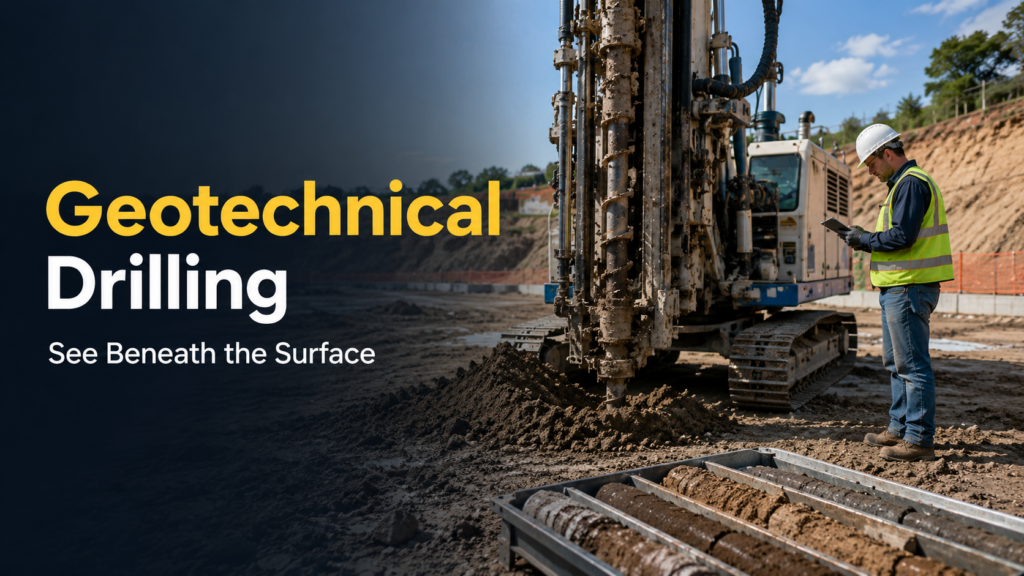
Geotechnical drilling gives engineers a verified, physical look at the soil, rock, and groundwater conditions hidden below a site, rather than leaving them to guess. The surface of a property tells you almost nothing about what is happening five, twenty, or fifty feet down — and that hidden layer is precisely what determines how a structure will perform over decades.
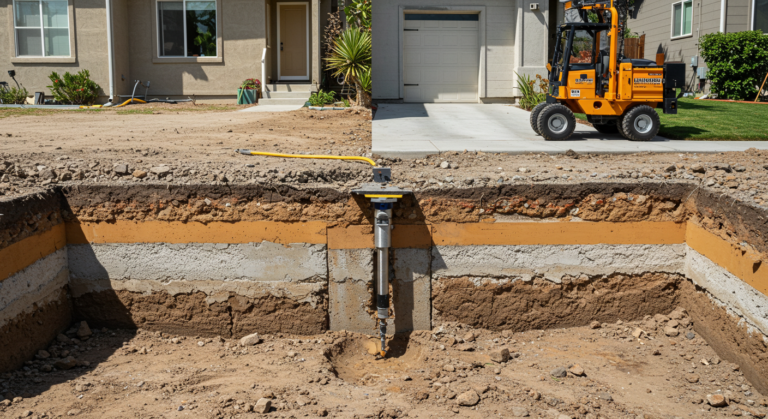
During a geotechnical investigation, a drill rig bores one or more holes (called borings) at planned locations across the site. As the bore advances, samples are pulled at set intervals and sealed for laboratory analysis. A licensed geotechnical engineer then reviews those samples and the field data to produce a soils report — the document that drives nearly every foundation, grading, and retaining decision that follows.
That report typically answers questions such as:
- Bearing capacity — how much weight the soil can support without failing
- Expansive soil potential — whether the soil swells and shrinks with moisture, a major issue across much of San Diego
- Groundwater levels — how high water sits and how it moves through the site
- Slope stability — whether a hillside is prone to creep or failure
- Seismic considerations — how the ground may behave during an earthquake
Without that information, an engineer is designing blind. With it, your foundation can be matched precisely to the ground it sits on.
How Does Geotechnical Drilling Work?
Geotechnical drilling follows a clear, repeatable sequence that turns raw ground into usable engineering data. While every site is different, the process generally moves through these stages:
- Site review and planning. The engineer determines how many borings are needed, how deep they should go, and where they should be placed based on the proposed structure and known site conditions.
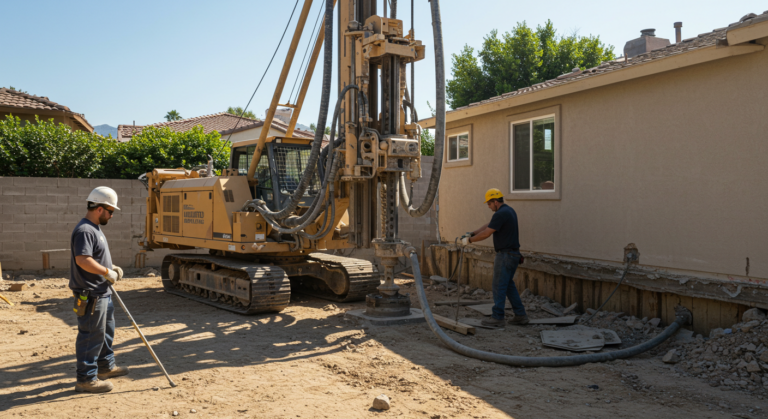
- Mobilizing the rig. A drill rig is brought to the site. On tight lots and steep San Diego hillsides, access is often the hardest part — which is exactly the kind of limited-access drilling we specialize in.
- Advancing the boring. The rig drills to the planned depth, commonly using hollow-stem auger or rotary methods depending on the soil.
- Sampling at intervals. Soil and rock samples are collected at regular depths, often using a standard penetration test that also measures soil density.
- Logging conditions. The field crew records soil types, moisture, groundwater, and any unusual layers encountered as the bore goes down.
- Laboratory testing. Sealed samples go to a lab to confirm strength, plasticity, expansion potential, and moisture content.
- Reporting. The geotechnical engineer compiles everything into a soils report with specific design recommendations.
The fieldwork on a typical residential project is often completed in a day or two. The engineering analysis and report that follow usually take longer, which is why it pays to start the process early rather than treating it as a last-minute formality.
When Do You Need Geotechnical Drilling?
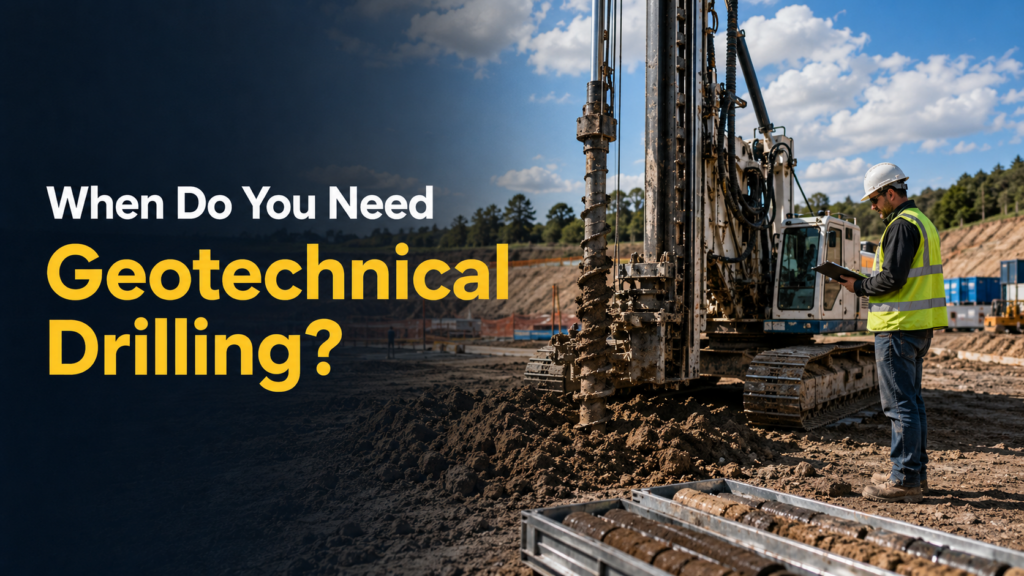
You need geotechnical drilling whenever the safety or stability of a structure depends on the ground beneath it — which covers far more projects than most property owners expect. In our experience across San Diego County, these are the situations that most often call for subsurface testing:
- Building a new home or structure, where the foundation must be designed for the actual soil conditions on the lot
- Building on or near a hillside, where slope stability and the risk of soil movement are central concerns
- Installing a significant retaining wall, where the wall’s footing and design depend on what the soil can hold
- Adding caissons or deep foundations, which must be sized and embedded based on subsurface data
- Repairing a failing or settling foundation, where the cause is frequently in the soil rather than the structure itself
- Buying or developing land where you need to confirm the site is buildable before committing
- Addressing recurring drainage or erosion problems that point to deeper soil or groundwater issues
In many cases, a local building department or your project engineer will require a soils report before issuing permits. Even when it is not strictly required, skipping it on a difficult site is a gamble — and the cost of getting it wrong almost always dwarfs the cost of the investigation.
San Diego’s Soil and Seismic Activity Raise the Stakes for Subsurface Testing
San Diego’s combination of expansive soils, steep coastal hillsides, and earthquake activity makes geotechnical drilling especially important here compared to flatter, more stable regions of the country. The soil type across much of the county is prone to expanding when wet and contracting when dry, which puts ongoing stress on foundations that were not designed for it.
We see the consequences regularly. Cracks in slabs and walls, uneven floors, and shifting retaining walls are often symptoms of soil behavior happening well below the surface. Areas like La Jolla and other steep hillside neighborhoods present some of the toughest conditions for both new construction and repair work anywhere in the country, and they reward careful subsurface investigation.
Seismic activity adds another layer. How the ground responds to shaking depends heavily on soil composition and groundwater, and that response directly informs how a foundation should be engineered. For property owners, the takeaway is simple: in San Diego, what you cannot see beneath your property is usually the thing that matters most.
What Geotechnical Findings Mean for Your Foundation and Caisson Design
Geotechnical drilling results are not just paperwork — they directly shape the foundation system, caisson depth, and retaining solutions that will keep your structure standing. Once the soils report is in hand, the engineering decisions that follow become grounded in real data instead of assumptions.
Here is how those findings translate into the work we do every day:
- Foundation type. Soil strength and expansion potential determine whether a conventional slab, a reinforced grade beam, or a deeper system is appropriate.
- Caisson depth and diameter. On unstable or hillside sites, caissons must reach down to competent material. We routinely drill caissons up to 50 feet deep and 36 inches in diameter, and the soils report tells us exactly how far to go.
- Retaining wall design. Footing size and wall construction depend on soil pressure and site conditions, which is why no two retaining walls are engineered the same way.
- Drainage planning. Groundwater findings guide how water should be managed so it does not undermine the structure over time.
Because Unlimited Drilling & Foundations Inc. handles drilling, caissons, foundation repair, slope stabilization, and drainage in house, we can take geotechnical recommendations and carry them straight through to a finished, code-compliant project — without handing your job off to a chain of subcontractors. That continuity is one reason we have completed more than 1,000 projects on time and within budget since 1993.
Frequently Asked Questions About Geotechnical Drilling
Is geotechnical drilling the same as a soil test?
They are closely related but not identical. Geotechnical drilling is the field method used to physically reach and collect soil samples, while a soil test refers to the laboratory and engineering analysis performed on those samples. The drilling provides the material; the testing and resulting soils report provide the conclusions.
How deep do geotechnical borings usually go?
Depth depends entirely on the project and the soil conditions. Borings for a typical residential foundation may reach a number of feet, while deep foundation or caisson work on hillsides can require investigation much further down. Your geotechnical engineer sets the required depth based on the structure and the site.
Who orders the geotechnical drilling — the homeowner or the engineer?
It varies by project. Often a geotechnical or structural engineer specifies what is needed, and a drilling contractor performs the work. In many residential cases, the property owner coordinates the investigation as part of permitting, and a full-service contractor can help manage that process from start to finish.
Can I build without a geotechnical report in San Diego?
In most situations involving new structures, hillsides, or significant foundations, a soils report is either required by the building department or strongly advisable. Building without one on a challenging San Diego site risks costly structural problems down the line. It is always best to confirm requirements with your local jurisdiction and engineer before starting.
How long does the geotechnical drilling process take?
The on-site drilling for a typical residential project is frequently completed within a day or two, depending on access and the number of borings. The laboratory testing and engineering report take additional time afterward. Difficult access, such as steep hillsides, can extend the fieldwork.
Plan Your San Diego Project on Solid Ground
Geotechnical drilling is the step that turns guesswork into certainty — it tells you and your engineer exactly what the ground can handle before you commit time and money to building on it. For projects across San Diego’s demanding soils and hillsides, that certainty is the difference between a structure that lasts and one that fights its foundation for years.
If you are planning new construction, a retaining wall, hillside work, or a foundation repair and want a crew that understands San Diego ground from the boring to the finished build, the team at Unlimited Drilling & Foundations Inc. is ready to help. We have been doing this work since 1993, we do it in house, and we are happy to walk you through what your specific site needs. Reach out for a free estimate and start your project on solid ground.