
If your energy bills spike every winter and your home never quite reaches the temperature on the thermostat, under-insulated attics and walls are usually the first place to look. Understanding the R-value needed for Indiana attics and walls is the starting point for every effective insulation upgrade — and getting it right means the difference between a home that holds its temperature and one that hemorrhages energy year-round.
R-value is a measurement of thermal resistance — how well a material slows the transfer of heat through it. The higher the R-value, the better the insulation performs. Indiana’s cold winters and humid summers demand higher R-values than many homeowners expect, and a significant number of existing homes in the Indianapolis area fall short of current recommendations. Here’s what the numbers actually mean for your home.
Indiana Falls in Climate Zone 5 — and That Determines Your Minimum R-Values

The U.S. Department of Energy divides the country into eight climate zones based on temperature, humidity, and heating and cooling demands. Most of Indiana sits in Climate Zone 5, which is classified as a cold climate — meaning homes here experience significant heating loads in winter alongside warm, humid summers. The southern tip of Indiana dips into Zone 4, which has slightly lower minimum requirements, but the vast majority of Indiana homeowners — including those in the Indianapolis metro area — are working with Zone 5 standards.
Climate zone matters because the DOE’s insulation recommendations, as well as the requirements in the International Energy Conservation Code (IECC) that Indiana’s building code is based on, are all tied directly to zone. A home insulated to Zone 3 standards would be dramatically under-insulated for an Indiana winter. Knowing your zone is the foundation for every insulation decision you make.
Indiana’s climate profile creates a specific challenge: insulation has to work hard in both directions. In January, it needs to keep heat from escaping through your attic and walls. In July, it needs to resist heat gain from the outside. That dual demand is why the DOE recommendations for Zone 5 are notably higher than the national average — and why so many older Indiana homes that were built to older code minimums are now underperforming on energy efficiency.
Indiana Attics Require Higher R-Values Than Most Homeowners Realize
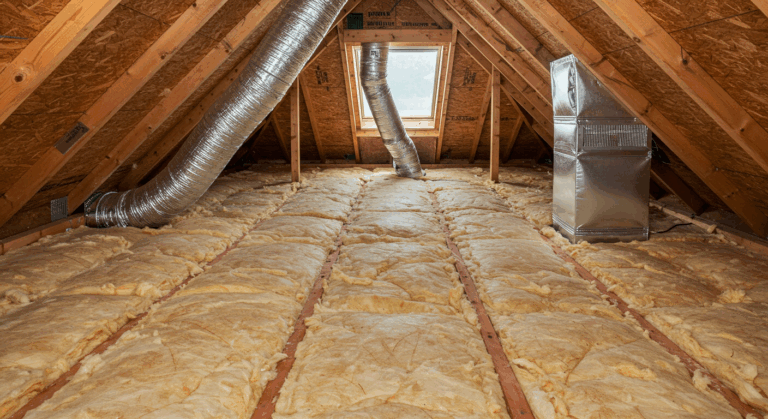
The attic is the single most impactful area for insulation in an Indiana home. Heat rises, and in an under-insulated attic, it escapes freely through the roof in winter and radiates downward into your living space in summer. The DOE recommends R-49 to R-60 for attics in Climate Zone 5 — a level that many Indiana homes, particularly those built before 2000, do not currently meet.
What the Code Requires vs. What the DOE Recommends
There’s an important distinction between minimum code requirements and DOE efficiency recommendations:
- IECC minimum for new construction (Zone 5): R-49 for unventilated attics, R-38 for ventilated attics with certain conditions
- DOE recommended range: R-49 to R-60 for most Indiana attics
- Existing homes with no insulation: The DOE recommends upgrading to at least R-38, with R-49 to R-60 as the target for maximum efficiency
- Existing homes with some insulation: Add insulation until you reach the R-49 to R-60 target, accounting for what’s already in place
For context, a typical older Indianapolis home may have only R-11 to R-19 of attic insulation — well below the current target. Upgrading to R-49 or higher is one of the highest-return insulation investments available to Indiana homeowners.
Best Insulation Types for Indiana Attics
Not all insulation is equally suited to attic applications. The most common options used by insulation contractors in Indianapolis include:
- Blown-in fiberglass or cellulose: The most common choice for attic floors. Easy to add depth over existing insulation, provides excellent coverage, and reaches R-49 to R-60 efficiently at relatively low cost.
- Batt and rolled insulation: Fiberglass batts work well for attic floors with regular joist spacing. Less effective at covering irregularities or obstructions without gaps.
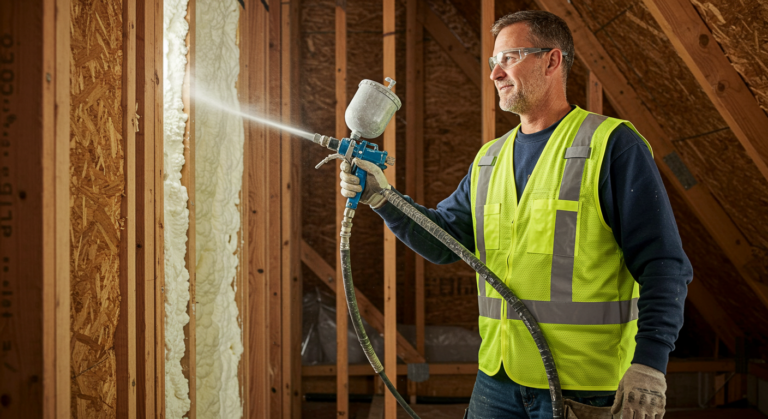
- Spray foam: Ideal for unventilated (conditioned) attics or sealing around penetrations and rim joists. Open-cell or closed-cell spray foam creates an air barrier in addition to thermal resistance.
- Radiant barrier: Applied to the underside of roof decking, radiant barrier insulation reflects radiant heat in summer — a useful complement to thermal insulation in Indiana’s hot months.
Indiana Wall Insulation R-Values Depend on Your Home’s Framing
Wall insulation requirements are more nuanced than attic requirements because they depend heavily on how your home was framed. The two most common scenarios in Indiana homes are 2×4 framing (standard in homes built before the 1990s) and 2×6 framing (more common in newer construction), and each has different insulation capacity.
2×4 Framed Walls
Standard 2×4 wall framing provides a cavity depth of approximately 3.5 inches. The DOE recommends R-13 to R-15 for wall cavities in Climate Zone 5 — which is achievable with high-density fiberglass batts, dense pack cellulose, or closed-cell spray foam in a 2×4 cavity. However, hitting R-15 in a 2×4 wall typically requires a higher-density insulation product rather than standard R-11 or R-13 batts.
2×6 Framed Walls
Homes with 2×6 framing have a 5.5-inch cavity that can accommodate R-20 or higher, which is what the DOE recommends for new construction in Zone 5. This deeper cavity is one of the primary energy efficiency advantages of 2×6 framing, and it’s worth filling completely rather than defaulting to a thinner batt.
Continuous Insulation for Walls
For homes where cavity insulation alone can’t reach target R-values — particularly in 2×4 framed homes — adding a layer of continuous insulation to the exterior is an effective solution. Rigid foam boards or continuous spray foam applied over the sheathing provide additional thermal resistance and also reduce thermal bridging through the studs, which standard cavity insulation doesn’t address. The DOE recommends an additional R-5 to R-6 of continuous insulation for Zone 5 walls where cavity depth is limited.
Dense Pack Wall Insulation for Existing Homes
For existing Indiana homes where walls are already drywalled and finished, dense pack cellulose or fiberglass is often the most practical upgrade. Installed by drilling small holes and blowing insulation under pressure to fill the cavity completely, dense pack wall insulation achieves R-13 to R-15 in a 2×4 wall without requiring demolition. Homeward Insulation specializes in dense pack wall insulation for Indianapolis-area homes, making it possible to bring older homes up to current R-value standards with minimal disruption.
What About Floors, Crawl Spaces, and Basement Walls?
Attics and walls get the most attention, but floors over unheated spaces, crawl spaces, and basement walls also have meaningful R-value requirements in Indiana’s Climate Zone 5.
- Floors over unheated spaces (e.g., over a garage or crawl space): DOE recommends R-25 to R-30 for Zone 5. Under-insulated floors over garages are a common source of cold floors and heat loss in Indianapolis homes.
- Crawl space walls (unvented crawl spaces): R-15 to R-19 is recommended. Vented crawl spaces are handled differently — insulation goes in the floor above rather than on the crawl space walls.
- Basement walls: The DOE recommends R-15 to R-19 for basement walls in Zone 5. Finished basements that are used as living space benefit most from wall insulation; unfinished basements should at minimum have rim joist insulation to prevent significant air leakage.
- Rim joists: Often overlooked but highly impactful. The rim joist — where the floor framing meets the foundation — is one of the leakiest areas in most Indiana homes. Spray foam is the most effective solution for sealing and insulating rim joists.
How Do You Know If Your Indiana Home Has Enough Insulation?
Many Indiana homeowners don’t know how much insulation they have — or don’t have — until an energy audit or insulation assessment makes it visible. Here are the most common signs that your home’s insulation isn’t meeting Zone 5 requirements:
- Heating and cooling bills that are noticeably higher than neighbors with similar-sized homes
- Rooms that are difficult to keep comfortable regardless of thermostat settings
- Cold floors, especially above garages or crawl spaces, in winter
- Ice dams forming on the roof edges during winter — a direct sign of attic heat loss
- Attic insulation that is visibly thin, compressed, or below the top of the floor joists
- Drafts near exterior walls, outlets, or window frames
A professional insulation assessment from Homeward Insulation includes a walkthrough of your attic, crawl space, and wall construction to identify where your home falls short of current R-value targets. From there, we recommend the right insulation type and depth for each area — and provide a clear, itemized estimate so you know exactly what the upgrade will cost and what you can expect to save.
Frequently Asked Questions About R-Values for Indiana Homes
What R-value is required by Indiana building code for new attic construction?
Indiana’s residential building code references the International Energy Conservation Code (IECC), which requires R-49 for attics in Climate Zone 5 under most new construction conditions. Some exceptions apply for low-slope or special attic configurations — your contractor or local building department can confirm the requirement for your specific project. For existing homes undergoing renovations, minimum requirements may differ from new construction standards.
How much insulation do I need to add to reach R-49 in my attic?
That depends on what’s already there. If your attic currently has R-11 of insulation, you need to add approximately R-38 more to reach R-49. Blown-in cellulose runs about R-3.5 per inch, so you’d need roughly 10 to 11 inches of additional blown-in insulation. Homeward Insulation measures your existing insulation levels before recommending how much material is needed to hit your target R-value.
Is R-13 enough for exterior walls in Indiana?
R-13 meets the minimum threshold but sits at the lower end of the DOE’s recommended range of R-13 to R-15 for Zone 5 wall cavities. For maximum efficiency in Indiana’s climate, R-15 in the wall cavity — supplemented with continuous exterior insulation where possible — is a better target. If your home has 2×4 framing, dense pack insulation can help you reach R-15 without requiring a wall tear-out.
Does the type of insulation material affect R-value?
Yes. Different insulation materials have different R-values per inch. Closed-cell spray foam provides approximately R-6 to R-7 per inch — the highest of any common insulation type. Open-cell spray foam runs about R-3.7 per inch. Blown-in cellulose provides about R-3.5 per inch, and fiberglass batts range from R-2.9 to R-3.8 per inch depending on density. Choosing the right material depends on the available cavity depth, air sealing needs, and budget.
Can Homeward Insulation assess my home’s current R-values and recommend upgrades?
Yes. Homeward Insulation serves Indianapolis and the surrounding Indiana area, providing professional insulation assessments and installation for attics, walls, crawl spaces, and basements. We evaluate your home’s current insulation levels, identify gaps and air leakage points, and recommend upgrades tailored to your home’s construction and your energy efficiency goals. Fill out the free estimate form on our website or contact us directly to schedule an assessment.
Meeting Indiana’s R-Value Requirements Is One of the Highest-ROI Home Upgrades You Can Make
Indiana’s Climate Zone 5 designation means your home’s insulation has to work harder than in most parts of the country — and the gap between what most older homes have and what current standards recommend is significant. Bringing your attic to R-49 or higher, your walls to R-13 to R-15, and your crawl space and basement to Zone 5 targets can meaningfully reduce your heating and cooling costs every year, improve comfort in every room, and extend the life of your HVAC system by reducing how hard it has to work.
At Homeward Insulation, we specialize in helping Indianapolis-area homeowners close that gap — whether that means blown-in attic insulation, dense pack wall upgrades, spray foam for rim joists, or a full-home insulation assessment. Fill out our free estimate form online and let us show you exactly where your home stands and what it would take to get it performing the way it should.