
Retaining walls are easy to ignore — until something goes wrong. Most homeowners don’t inspect theirs regularly, which means the early warning signs of failure often go unnoticed until the problem becomes expensive or dangerous. Knowing the signs a retaining wall is failing early can mean the difference between a manageable repair and a full replacement — or worse, a sudden collapse that damages your property and the structure above it. At Unlimited Drilling & Foundations, we’ve been building and repairing retaining walls throughout San Diego County since 1993, and we see the same warning signs overlooked again and again. Here’s what to look for.
A Wall That Looks Fine on the Surface Can Already Be Failing Structurally
This is the part that catches most homeowners off guard. Retaining wall failure rarely announces itself all at once. It builds gradually — often over years — driven by water pressure, soil movement, and the slow deterioration of drainage systems that were never adequate to begin with. By the time a wall is visibly bowing or cracking severely, it has usually been struggling for a long time.
In San Diego, this process is accelerated by a combination of factors that make retaining wall failure more common here than in most of the country:
- Expansive clay soils — Much of San Diego County sits on clay-heavy soils that absorb water and swell during wet months, then dry out and contract in summer. This cycle places enormous, repeated pressure on retaining walls over time.
- Hillside terrain — Steeply sloped lots in neighborhoods throughout San Diego — from La Jolla to El Cajon to Chula Vista — mean retaining walls are holding back significant soil loads, often on properties where the wall was never engineered to handle the actual forces involved.
- Seismic activity — Ground movement from earthquakes, even minor ones, shifts the soil behind retaining walls and can accelerate deterioration that was already in progress.
- Aging construction — Many retaining walls across San Diego were built decades ago without engineered drainage, proper footings, or materials suited to our soil conditions. Age alone doesn’t cause failure — but age combined with inadequate original construction does.
The Most Serious Signs a Retaining Wall Is Failing
Some warning signs are more urgent than others. These are the ones that should prompt you to contact a professional quickly rather than monitor and wait:
The Wall Is Leaning or Bowing Outward
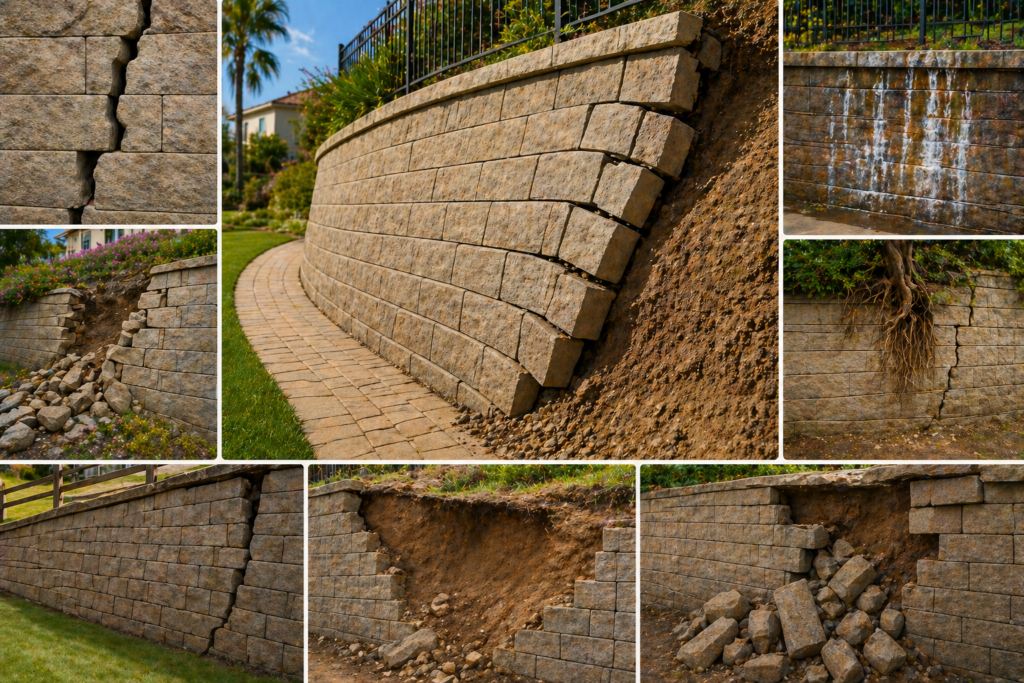
A retaining wall that is visibly tilting away from the soil it holds — even slightly — is one of the clearest indicators of structural failure in progress. This happens when the pressure behind the wall exceeds what the wall and its footing were designed to resist. Once a wall begins to lean, that movement rarely stops on its own. The further it tilts, the more the pressure increases, and the more likely it becomes that the wall will eventually collapse. Any visible lean warrants an immediate professional evaluation.
Horizontal Cracks Running Across the Wall Face
Horizontal cracks are the most serious type of crack a retaining wall can develop. They indicate that the wall is being pushed outward by soil pressure and can no longer distribute that load effectively through its structure. A wall with significant horizontal cracking — particularly one that is also bowing at the crack location — should be treated as a structural emergency. The wider the crack and the more pronounced the bow, the more urgent the situation.
Water Actively Seeping Through the Wall Face
Retaining walls are supposed to manage water through weep holes or drainage systems built into the back of the wall. When water starts pushing visibly through the face of the wall — through cracks, mortar joints, or the material itself — it means drainage behind the wall has failed. Water is the leading cause of retaining wall failure in San Diego. When it can’t escape through the designed drainage path, it builds up as hydrostatic pressure that exerts a constant, powerful outward force on the wall. A wall that is actively weeping water is a wall under significant stress.
Erosion or Voids at the Base of the Wall
The soil directly behind and beneath a retaining wall footing provides a significant portion of the wall’s resistance to overturning. When that soil erodes — from poor drainage, surface water runoff, or subsurface movement — the wall loses its base support. Visible erosion channels at the base, exposed footing concrete, or soft, saturated soil at the wall’s toe are all indicators that the wall’s foundation is being compromised.
Gaps Opening Between Blocks or Wall Sections
On segmental block or masonry retaining walls, gaps opening between individual units are a sign that the wall is moving — either settling unevenly or being pushed outward at specific points. Stair-step cracking patterns through mortar joints in block or brick walls indicate differential movement and are a signal that the underlying footing or soil conditions are not uniform. Even small gaps should be monitored, and gaps that are growing should be evaluated professionally without delay.
Why Do Most Retaining Walls in San Diego Fail?
After more than three decades of building and repairing retaining walls across San Diego County, the root cause we find most often is the same: inadequate drainage combined with insufficient footings. Almost all wall failures come back to one or both of these issues.
Water is the force that destroys retaining walls — not soil weight alone. When a wall is backfilled with native clay rather than clean gravel, and when no perforated drain pipe is installed to relieve water pressure, every rainfall adds to the hydrostatic load building up behind the wall. Over time, that pressure pushes the wall outward no matter how well it was built above grade.
Footings that are too shallow, too narrow, or poured over uncompacted fill are the second most common failure point. A wall is only as stable as what it stands on. In San Diego’s hillside terrain, many older walls were installed with footings that would have been adequate on flat ground with stable soil — but were never sufficient for sloped lots, expansive clay, or the soil loads present on canyon-adjacent properties.
Secondary Warning Signs You Should Not Ignore
Beyond the most urgent structural signals, these secondary signs indicate a wall that is deteriorating and should be evaluated before the damage progresses further:
- Patios, driveways, or decks adjacent to the wall tilting or cracking — Surfaces built near a retaining wall often move with it. A patio that wasn’t sloped before, or a driveway section that is now cracking along its edge nearest the wall, is a sign the wall may be moving.
- Soil slumping or mounding at the wall’s base — Visible accumulation of soil at the toe of the wall, or areas where the ground surface appears to have slumped down from behind the wall, indicates soil is moving through or around the structure.
- Vegetation growing in wall joints — Tree roots and large shrubs growing in or directly behind retaining walls exert significant outward pressure as they grow. They also channel water directly into the wall structure. This isn’t just a cosmetic issue.
- Efflorescence — white staining on the wall face — White mineral deposits on the surface of a concrete or masonry wall indicate that water is regularly moving through the wall material. It’s not structurally critical on its own, but it confirms that drainage behind the wall is inadequate.
- The wall is more than 20–30 years old with no history of maintenance — Age alone doesn’t mean failure, but older walls built without modern drainage standards deserve a professional inspection, particularly in San Diego’s climate and soil conditions.
When Is Retaining Wall Repair Enough — and When Is Replacement the Right Answer?
This is the question homeowners most want answered once they’ve spotted a problem. The honest answer is that it depends on what’s actually failing, and the only way to know for certain is a professional site evaluation.
Repair is often viable when the wall structure itself is sound but drainage has failed, when isolated sections of a block wall have moved but the footing is stable, or when a wall is leaning but hasn’t yet exceeded the point where reinforcement can restore it to structural adequacy.
Replacement is typically the right answer when the footing has failed entirely, when the wall has moved beyond the range where it can be stabilized in place, when drainage issues are so severe they cannot be addressed without demolishing the wall to install proper systems, or when the original wall was never engineered to handle the actual loads on the site. A wall that has partially collapsed, or one that is continuing to move despite previous repair attempts, almost always requires replacement.
At Unlimited Drilling & Foundations, our retaining wall solutions include concrete retaining walls, steel beam and pipe pile walls for extreme slopes, and GeoGrid systems for slopes that have previously experienced landslide or mudslide failure. We design each solution around the specific soil conditions, load requirements, and terrain of your property — not a one-size approach. If your wall is showing any of the signs covered above, contact us for an honest, no-obligation assessment.
Frequently Asked Questions About Retaining Wall Failure
How quickly can a failing retaining wall collapse?
There is no predictable timeline. A wall that has been slowly deteriorating for years can remain standing for a long time — or can collapse suddenly following a heavy rain event or seismic activity that adds the final load increment the wall can no longer resist. This unpredictability is exactly why visible warning signs should never be monitored indefinitely without a professional evaluation.
Is a leaning retaining wall always an emergency?
Any visible lean warrants prompt professional attention, but not every lean is an immediate emergency. A wall that has developed a slight lean over many years is in a different situation than one that has moved suddenly or is continuing to move. A structural evaluation will determine whether the wall requires emergency stabilization, scheduled repair, or replacement planning.
What causes a retaining wall to crack?
Horizontal cracks are almost always caused by excessive soil pressure pushing outward — typically made worse by water buildup behind the wall. Vertical cracks can result from differential settlement of the footing or thermal expansion and contraction. Stair-step cracks in block or masonry walls indicate differential movement across the wall’s length. The type, location, and width of cracks all factor into how serious the underlying problem is.
Does a failing retaining wall affect my homeowner’s insurance?
It can. Some policies exclude coverage for damage caused by earth movement or gradual deterioration — both of which are involved in most retaining wall failures. A retaining wall collapse that damages a neighboring property can also create significant liability exposure. Addressing deterioration before failure occurs protects both your insurance position and your liability exposure.
Do I need a permit to repair or replace a retaining wall in San Diego?
In most cases, yes. The City of San Diego and San Diego County require permits for retaining walls exceeding three feet in height (measured from the bottom of the footing), and for any wall — regardless of height — that supports a surcharge load such as a driveway, pool, or structure. Permitted work also requires engineering plans in most structural repair or replacement scenarios. Working without a permit on structural retaining wall work creates significant legal and safety risk.